Costs
Part of Headshots and presentation: the neckline, jacket and tone
The costliest headshots and presentation mistakes, explained
Headshots and presentation mistakes made after the session: lost originals, crops of crops, inconsistent images, and the photograph left to go stale.
Most of what goes wrong with a professional photograph happens after the photograph exists. The session is an hour. Everything afterward, which is where the image is cropped, compressed, uploaded, duplicated and left to go stale, lasts for years and gets no attention at all.
These are the mistakes of that longer period, plus the two made during the session that cannot be corrected later. Each one has a cost, and the costs are not what people expect.
What to take away
- Keep the full-resolution original and crop from it. Every crop made from a crop loses quality permanently.
- One image, used everywhere, is worth more than several good ones used inconsistently.
- The image goes stale on a schedule, and the schedule is shorter than most people assume.
Mistakes made after the session
Losing the original
A photograph that only exists as the version uploaded to one site is a photograph you no longer control. Sites compress, resize and sometimes crop, and the file that comes back down is not the file that went up.
Original vs. degraded file
Original file
- Resolution
- Full
- Detail
- Intact
- Control
- Yours
- Future use
- Any size
Re-exported file
- Resolution
- Reduced
- Detail
- Lost
- Control
- Site's
- Future use
- Limited
Keep the original at full resolution, in a place you will find it in three years, and export from it every time.
Cropping from a crop
Each export from an already-cropped, already-compressed file loses detail. The loss accumulates invisibly until it becomes visible all at once at a larger size.
Export a fresh version from the original for each use, at the size that use requires.
Using different photographs in different places
A conference program, an internal directory and a professional profile showing three different images make you harder to recognize, which is the one job the picture has. Consistency beats quality here: the same adequate photograph everywhere outperforms three good ones.
Ignoring the small version
Most people will see the image at a size where the face occupies a fraction of an inch. A photograph designed for a large display and then shrunk becomes a smudge, and this is the single most common failure.
Look at the image at the size it will actually appear before choosing it. That constraint drives most of the composition decisions described in the guide to headshots and presentation.
Over-retouching
A retouched image that does not match the person who walks in is a bad outcome for a photograph whose purpose is recognition. Remove what is temporary and leave what is permanent, which is a simple rule that resolves nearly every case.
Letting it go stale
An image that no longer resembles you is worse than no image. Appearance changes, and the point at which people are surprised on meeting you is the point at which the photograph has failed.
Reshoot when your appearance has changed in a way you notice, and otherwise every few years. It is the cheapest thing on this page.
The two that cannot be fixed later
Wardrobe and background are decided in the session and are not editable in any real sense.
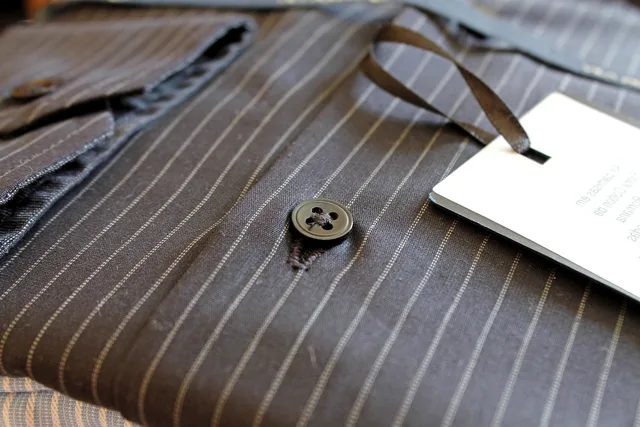
Fine repeating patterns interact badly with a sensor and can produce visible artifacts. High contrast at the edges of the frame pulls attention off the face. Both are properties of what you wore, and no adjustment afterward removes them.
What reads well in a room and what reads well through a lens are not the same. That is why the register described in the guides to business casual for women and business casual for men does not transfer to a camera unchanged.
A cluttered or badly lit background is technically editable and practically not, because separating a person from a busy background convincingly is more work than reshooting.
The costs, ranked
| Mistake | What it actually costs | Fix |
|---|---|---|
| Lost original | Every future version, permanently degraded | Archive the file today |
| Crop from a crop | Visible quality loss at larger sizes | Export from the original |
| Inconsistent images | Recognition, which is the whole purpose | Pick one and use it everywhere |
| Wrong for the small size | Most of the views the image will ever get | Check at the real size |
| Over-retouching | Credibility on first meeting | Remove the temporary only |
| Stale image | The same, more slowly | A reshoot every few years |
| Pattern and contrast | The session | Plan the wardrobe first |
The first four are free to avoid and are the ones most often missed.
What is not a mistake
Wearing the same thing you actually wear to work is not a mistake; it is the point. Looking like yourself is not a mistake. Using a photograph taken by someone competent rather than a studio is not a mistake either, provided the light and the background are controlled.
And treating this as a wardrobe decision as much as a photographic one is correct, because it is. The formal end of that range is set out in business formal, and where a workplace has requirements that reach the photograph, those follow the sector patterns described in the guide to industry dress codes.
Where an employer uses images in a hiring process, that is a different subject with its own considerations. The federal agency responsible for employment discrimination publishes an overview of employment tests and selection procedures as well as a summary of prohibited employment policies and practices. Neither is a guide to photography, and both are worth knowing exist.
Common questions
How often should a professional photograph be replaced?
When your appearance has changed enough that people would be surprised, and otherwise every few years. Nothing about a photograph ages well except the file format.
Should the same image be used for a formal and an informal context?
Yes, if it is pitched at the middle. An image at the extreme of either end will be wrong in the other, and consistency is worth more than precision here.
Is a phone photograph acceptable?
Frequently, if the light and background are controlled and the lens is not too close to the face. The camera is rarely the limiting factor; the distance and the light are.
What size file should I keep?
The largest the photographer gives you, uncompressed if possible. Storage is cheap and there is no way back once the original is gone.