Costs
Part of Work dresses: knit against woven, and the fiber label that decides fit
Work dresses styles: the practical version
Six work dresses styles compared by where each is held and released: stride, alteration cost, and the kind of working day each silhouette survives.
Dress silhouettes have names, and the names are not decoration. Each one describes where the garment is held to the body and where it is released, and that single fact predicts how it moves, what it costs to alter, and which kind of working day it can survive.
Six shapes cover almost everything sold for work. This page describes what each one is actually doing and what it asks of the person wearing it, so the choice can be made on function rather than on a photograph.
What to take away
- A silhouette is a statement about where the garment is held and where it is loose. Everything else follows from that.
- Shapes held at the waist restrict the stride unless there is a vent or stretch. Shapes released from above do not.
- Alteration cost tracks the number of shaped seams, so the most adjustable shapes are also the most expensive to buy.
The six
The sheath
Held at the bust, the waist and the hip, released nowhere. It is the most fitted of the six, which means it shows the most and forgives the least. Shaping is done with darts or princess seams, and a vent at the back is what makes walking possible.
It suits a day that is mostly indoors and mostly still. It is the shape most dependent on accurate alteration, and the one where a good tailor changes the result the most.
The shift
Held at the shoulder, released below. The body hangs from the shoulder seam, so the fit at the shoulder is nearly the whole judgment and the waist measurement matters very little.
It is forgiving through the middle, comfortable for long sitting, and reads as less formal than a sheath because there is less structure. It is also the easiest of the six to get wrong at the shoulder, and the shoulder is the expensive alteration.
The wrap
Held by a tie at the waist, closed by overlap rather than by a fastening. It accommodates a wider range of measurements than any other shape because the closure is adjustable.
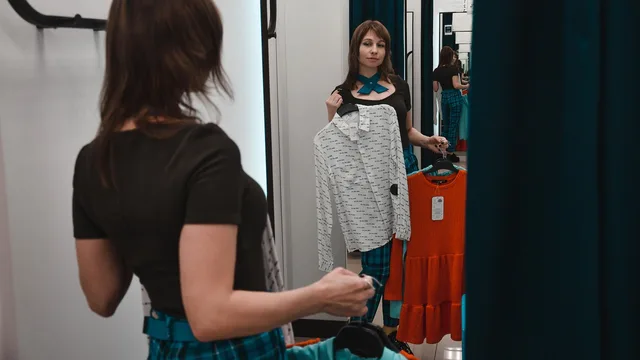
The trade is that the overlap has to be checked for how it behaves when you reach forward and when you sit. Do both in the fitting room. A wrap that gaps at the chest under movement will gap in every meeting.
The shirt dress
Held by a front placket from neck to hem, usually with a belt at the waist. It is the most adjustable of the six for temperature, because the collar and the sleeves can be opened.
Its failure point is the placket, where the buttons take strain at the bust and the hip. Check both while seated.
The fit and flare
Held at the bust and waist, released sharply below into a fuller skirt. It allows a full stride without a vent, which is a real advantage on a day with distance in it.
It uses more cloth, so it creases more and packs badly. The fuller the skirt, the harder and more expensive the hem is to alter, because a flared hem has to be reshaped rather than simply raised.
The A-line
Held at the shoulder or bust, widening steadily to the hem. It sits between the shift and the fit and flare, and it is the most generally useful of the six for a working week because it moves well and shows little.
Comparing them
Held at
- Sheath
- Bust, waist, hip
- Shift
- Shoulder
- Wrap
- Waist, by tie
- Shirt dress
- Front placket
- Fit and flare
- Bust and waist
- A-line
- Shoulder or bust
Stride
- Sheath
- Needs a vent
- Shift
- Free
- Wrap
- Free
- Shirt dress
- Free if belted loosely
- Fit and flare
- Free
- A-line
- Free
Alteration cost
- Sheath
- High, and worth it
- Shift
- Low, except the shoulder
- Wrap
- Very low
- Shirt dress
- Low
- Fit and flare
- High at the hem
- A-line
- Moderate
Best for
- Sheath
- Still, indoor days
- Shift
- Long sitting
- Wrap
- Changing measurements
- Shirt dress
- Variable temperature
- Fit and flare
- Days with distance
- A-line
- General use
What the table does not show
Cloth changes every row. A sheath in a cloth with recovery behaves differently from the same cut without. A shift in heavy cloth hangs; in light cloth it floats.
Read fiber content before shape. The FTC guidance on textile and wool labeling sets out what that statement must disclose. The generic fiber names on it are the part you can rely on.
Lining changes two rows. An unlined sheath or shift will cling and ride; a lined one will not. Whether a lining can be added later is a question for a tailor with the garment in hand, and the answer usually depends on the neckline.
Choosing between them
Start from the day rather than from the shape. A day that is mostly seated wants a shift or an A-line. A day with a long walk in it wants a released hem or a vent. A day where the register has to be high wants the most structured option that still allows the movement the day requires.
Check the alteration cost against how long you expect to keep it. Use the same logic as the guide to work dresses.
The wider decision order for a wardrobe built this way is in women's professional wear, and how the shape reads against the rest of an outfit is in the guide to business casual for women.
Where the shape is not yours to choose
Some workplaces constrain hems, sleeves, and closures for reasons unrelated to appearance, such as loose cloth near equipment or coverage requirements in food handling and clinical settings. These limits come from a hazard assessment, not a style policy, and the obligation appears in the OSHA general requirements for personal protective equipment.
Which sectors do this, and how can you find out before your first day? The guide to industry dress codes covers that.
Common questions
Which shape is most forgiving of weight change?
The wrap, because the closure is adjustable, followed by the shift, because nothing is held at the waist. The sheath is the least forgiving by a wide margin.
Is a vent necessary on every fitted dress?
On anything narrow at the knee, yes, unless the cloth has real stretch. Without one the stride is limited to the hem circumference and the seam takes the strain.
Can a fit and flare be shortened?
Yes, but it is a reshaping rather than a simple hem, so price it before you buy. A straight hem is a routine job and a flared one is not.
Does the shape decide the formality?
Partly. Structure and surface decide more. A sheath in a soft, textured cloth can read less formal than an A-line in a smooth, dense one.