Industry
Work dresses: knit against woven, and the fiber label that decides fit
Work dresses compared knit against woven, with the fiber label read before the size label, and the alteration economics that favor the dress.
Work dresses split into two constructions, knit and woven, and the fiber label tells you which one you are holding before the size label says a word. A dress is the only garment that gets you dressed in one decision. There is no second garment to correct the first, so the decision has to be a good one.
This page covers where that decision succeeds or fails. That almost always happens in parts of the dress you cannot see on the hanger.
Budget and premium are not prices. They describe where a maker chose to spend and where it chose to save. Once you see the choice, you can decide whether it matters for your day.
What to take away
- The money in a dress goes into five placescloth, lining, cut, closure and finishing. A budget dress saves on two or three of them, and which ones decide whether it works.
- Knit and woven dresses fail in different ways. Choose the failure you can live with.
- A dress is the garment where alteration economics are most favorable, because the hem and the waist seam do most of the work and both are routine.
- Named examples on each sideEileen Fisher washable stretch crepe and the M.M.LaFleur Etsuko are knits; the Talbots seasonless wool sheath and the Brooks Brothers wool sheath are wovens.
Where the money goes
Turn the dress inside out. Everything below is visible in the shop with no tools.
What the budget version does
- Cloth
- Lighter, often with a higher synthetic share, so it creases less but breathes less
- Lining
- None, or a half lining
- Cut
- Fewer pattern pieces, fewer seams, less shaping
- Closure
- A light zip set into thin cloth
- Finishing
- Overlocked raw edges, narrow hem allowance
What the premium version buys
- Cloth
- Heavier, more natural fiber, holds a line and drapes
- Lining
- Full lining that takes the friction and stops cling
- Cut
- More seams, which means more shaping and more alteration room
- Closure
- A solidly mounted zip in a reinforced seam, or buttons with a placket
- Finishing
- Bound or turned edges, a generous hem
Does it matter for you?
- Cloth
- Yes, if the day involves heat or six hours of sitting
- Lining
- Yes for a woven dress; often no for a knit
- Cut
- Yes, if it will be altered
- Closure
- Yes; this is the most common point of failure
- Finishing
- Yes, if you want it hemmed or kept for years
The last column is the one that saves money. A knit with no lining has not compromised on the lining; it never needed one.
Eileen Fisher's washable stretch crepe is unlined for that reason, and so is the Universal Standard ponte group. A woven dress with no lining and a light zip has compromised twice, and the second compromise is the one that will end its life.
Named work dresses, knit against woven
The rows below are current lines you can buy today. Prices are typical list prices at each brand's own store as of 2026; sales move them.
| Dress | Construction | Fiber label, first word | Lining and closure | Typical list price | Sizes |
|---|---|---|---|---|---|
| Eileen Fisher washable stretch crepe shift | Knit crepe | Viscose blend with a little elastane | Unlined, pulls on | $198 to $258 | XXS to 3X |
| M.M.LaFleur Etsuko | Japanese stretch crepe knit | Synthetic blend | Unlined, pulls on | $285 to $325 | 00 to 18 |
| Universal Standard ponte sheaths | Ponte double knit | Rayon or polyester with elastane | Unlined, pulls on | $120 to $160 | 00 to 40 |
| Lands' End ponte sheath | Ponte double knit | Polyester blend | Unlined, pulls on | $80 to $120 | 2 to 18, petite and tall |
| Talbots seasonless wool sheath | Woven wool blend | Wool first | Fully lined, back zip | $179 to $229 | 0 to 24, petite and plus |
| Brooks Brothers wool sheath | Woven wool | Wool first | Fully lined, back zip | About $248 | 00 to 16 |
| Calvin Klein stretch wool sheath | Woven wool blend | Wool or polyester first | Fully lined, back zip | About $134 | 2 to 16 |
Read the table by column. Every knit row pulls on, so the zip question never comes up. Every woven row is lined and closes with a back zip, the seam most likely to fail first, so open and close that zip twice in the shop.
Price tracks fiber and finishing rather than construction. A $120 Universal Standard ponte and a $248 Brooks Brothers wool sheath have one thing in common: neither compromised on the lining, because one never needed it and the other paid for it.
The knit that suits a long sitting day is a ponte, at Universal Standard or Lands' End. It is machine washable, it recovers, and it lists for less than the wool sheaths. The woven that suits a client day is the wool sheath at Talbots or Brooks Brothers.
Knit or woven, and what each one asks of you
The two constructions are not better or worse. They are different bargains.
A knit stretches, recovers and travels well. It sits through a long day and gets up looking the same. In exchange it pills at points of friction, it slowly grows at the elbow and the seat, and it shows the line of whatever is underneath it.
It is the right dress for a day that is mostly sitting and moving. Eileen Fisher's washable crepe and the M.M.LaFleur Etsuko are built for it, and both go into a machine on cold.
A woven holds its line, resists pilling, and reads as more formal from across a room. In exchange, it creases where it is folded and cannot absorb movement. It needs seams and lining to do the work stretch does in a knit.
The Talbots seasonless wool sheath and the Brooks Brothers wool sheath are that construction. It is the right dress for the day a client is in the building, the day closest to the register described under business formal.
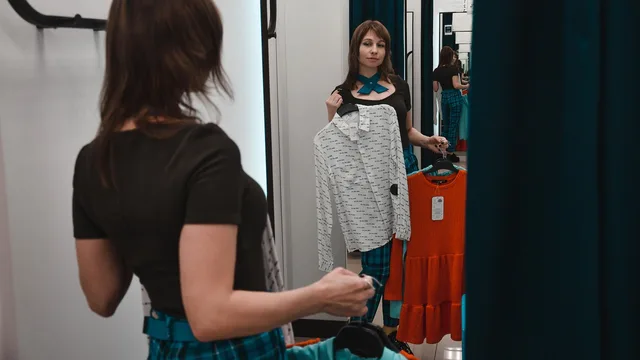
Test either one the same way. Sit down in it for a minute in the changing room, reach forward as if to a keyboard, and stand up. What you see in the mirror is three in the afternoon.
Read the fiber label before the size label
Fiber content is printed inside the garment because the law requires it. It is the single best predictor of how the dress will behave.
The rules under the textile fiber products identification act require fibers to be listed in order of their share of the garment. The first word on the label decides how it creases, breathes, pills and washes.
A dress whose first fiber is natural will breathe and crease. One whose first fiber is synthetic will hold a shape and hold heat. Blends sit between, and a modest share of stretch fiber in an otherwise natural cloth is often the best of both.
Ponte, the double knit in the Lands' End and Universal Standard rows, is usually a rayon or polyester blend with a few percent of elastane. That is why those dresses pull on and keep their shape after a wash.
The Talbots and Brooks Brothers sheaths list wool first, which is why they hold a line and need a lining to slide over a blouse. None of this is about quality. It is about matching the cloth to the day.
Sleeves, necklines and the room
Before anything about the room: in some workplaces sleeve fullness, hem length and coverage are set by a hazard rather than by taste, and that requirement follows the employer's assessment under the OSHA general requirements for personal protective equipment. Where no hazard applies, the rest of this section does.
Two design decisions change what the dress can do, and neither is about how you look.
A sleeve decides whether a dress works alone or needs a layer. A sleeveless dress is a summer dress in a cold building, so it needs a jacket that closes over it. Most ponte sheaths at Lands' End and Universal Standard come in a sleeveless cut and a short-sleeved one.
A dress with a sleeve is complete alone, but it must fit at the shoulder, the seam that cannot be moved. A three-quarter sleeve is the practical compromise, which is why so many working dresses have one.
A neckline decides how the dress reads on camera and how it takes a necklace or a collar. Higher and plainer necklines survive a video call, where everything below the chest is out of frame.
The neckline does all the work there. The camera side of this is set out in the guide to business casual for women.
Alteration economics, which favor the dress
A dress is the garment where a tailor can do the most for the least, because its fit is decided at two seams that are both routine.
- The hem.The cheapest alteration in the trade, typically $15 to $35, and the one that changes how a dress reads at distance more than any other. Buy long.
- The waist seam.On a dress with a seam at the waist, taking it in or letting it out is straightforward, typically $20 to $45, and a maker who left seam allowance there has given you years of adjustment.
- The side seams.Routine on an unlined dress, typically $25 to $50, and more on a lined one.
- The shoulder and the armhole.Not worth it. Buy for these.
- Relining.Possible but rarely worth the cost, typically $80 to $150 on an ordinary dress.
The practical rule is to judge the dress in the shop by the shoulder and the upper back. Count the hem and the waist as part of the purchase price rather than as a later repair. A knit that pulls on has no zip to fail and often no waist seam to move.
That is the same order of decisions used for tailored garments generally, set out in men's professional wear, and the dress simply reaches the result with fewer seams. A $90 Lands' End ponte that fits at the shoulder will beat a $248 wool sheath that does not.
Where the money belongs in a dress
If the budget is limited, put it into the cloth and the closure, in that order, and accept a simpler cut. Cloth is what you feel all day and the closure is what fails first. Cut and finishing are what a tailor can improve; cloth and closure are not.
If the budget is not limited, the return on premium still stops somewhere. Past the point where the cloth has weight, the lining is full, the zip is sound and the seam allowance is generous, additional money is buying a name or a print. Both are legitimate purchases. Neither is a better dress.
For the whole wardrobe the dress sits in, and how it pairs with what is already there, the grid method in women's professional wear treats the dress as its own row. It is the one garment that does not need to pair with anything, and that makes it the easiest place in a wardrobe to buy well.
Common questions
Is a lined dress always better than an unlined one?
For a woven cloth, usually. For a knit, the lining removes the stretch that was the reason to choose a knit. Judge the lining against the cloth, not on its own.
What is the first thing to check?
The zip. Open and close it twice, and look at the cloth it is set into. A light zip in a thin seam is the most common reason a dress is retired long before the cloth is worn.
Should I buy a size up and have it taken in?
Only if the shoulder fits at the larger size. If it does not, taking in the body will leave a dress that fits everywhere except the one place a tailor cannot reach.
Can the same dress work for a formal day and an ordinary one?
A plain woven dress in a dark color can, with the jacket and the shoes doing the work of moving it between registers. A knit or a print cannot, because the cloth itself belongs to the casual side.
Which of the named dresses is the safest first buy?
For a week of sitting and travel, a ponte sheath from Universal Standard or Lands' End. For a week with clients in the room, the Talbots seasonless wool sheath or the Brooks Brothers wool sheath.
In this guide
- Building a work dress wardrobe around one layer, not endless dressesFifteen work dresses ideas built on one system: the dress plus one layer, chosen for temperature, register or movement, and how to buy into it.
- How to care for work dresses, check them before buying, and repair themA practical guide to work dress care: how washing and dry cleaning cause wear, which repairs are worth making, and what to inspect before buying.
- Work dress mistakes caught in the fitting room, one seam at a timeNine work dresses mistakes made in the fitting room, each with the test that catches it: seam allowance, the seated hem, the zipper and the cloth.
- Work dresses styles: the practical versionSix work dresses styles compared by where each is held and released: stride, alteration cost, and the kind of working day each silhouette survives.
- Work dresses examples worth copying, and whyTwenty work dress examples that survive a year of wear, with the construction detail, the brand behind each, and the reason it earns a place.