Costs
Men's professional wear: what to check in the jacket, cloth, trouser and shirt
Men's professional wear in the order decisions must be made: checking a jacket from the inside, judging cloth by weight, and reading trouser and shirt numbers.
A tailored jacket is a built object. Between the cloth you see and the lining you feel sits a third layer. How that layer is attached decides how the jacket sits on day one, after a year, and whether it can be pressed back into shape when it goes wrong.
None of that shows on a hanger. All of it shows in about a minute if you know where to put your hands.
This page is about that minute, repeated across the jacket, the trouser and the shirt. It is also about the order of decisions, so that the one you cannot undo is made first.
What to take away
- Decide in the order of what cannot be changed. The shoulder and the chest of a jacket are fixed; almost everything below them is adjustable.
- Quality is read from the inside. A floating chest layer, a lapel that rolls rather than folds, pattern that continues across seams: none of these cost you anything to check.
- The label on a shirt or trouser is a set of measurements. Use them, and use the fiber label with the same seriousness.
The order of decisions
Most men buy in the wrong order: color first, then price, then whether it fits. Reverse it. The first question is whether the garment fits at the points a tailor cannot reach. A yes there makes everything else negotiable; a no makes everything else irrelevant.
Fit order: fixed points first
Shoulder width: can it be altered? No, in practice
Chest: barely; front must lie flat buttoned
Jacket length: a little, at cost to pocket position
| Point | Can it be altered? | What to check |
|---|---|---|
| Shoulder width | No, in practice | The seam ends where your shoulder ends; no divot below it, no overhang beyond it |
| Chest | Barely | Buttoned, the front lies flat with no pull line from the button to the shoulder |
| Jacket length | A little, from the hem, at a cost to the pocket position | The hem covers the seat; do not rely on shortening |
| Sleeve length | Yes, cheaply, unless there are working cuffs | A band of shirt cuff shows below the jacket sleeve |
| Jacket waist | Yes | Taking it in is routine; letting it out depends on what was left inside |
| Trouser waist | Yes, within a size either way | Look inside for the spare cloth at the center back seam |
| Trouser length | Yes, cheaply | Buy long and have it hemmed |
| Trouser seat and thigh | Some | Letting out is limited by the seam allowance; taking in is easy |
Read the table from the top. If the first two rows fail, walk away, whatever the price. If they pass, the rest is a matter of a tailor's afternoon.
Reading a jacket from the inside
Pick up the front of the jacket below the lapel, between thumb and forefinger, and rub the two faces against each other. In a well-made jacket you can feel a third layer moving independently between the cloth and the lining. That is the canvas. It gives the chest its shape and lets the lapel roll.
In a jacket where the shaping layer has been glued to the cloth instead, the front feels like a single stiff sheet. It looks fine on the first day. Over time, and especially after cleaning, the glued layer can separate from the cloth and produce bubbles across the chest that no press will remove.
Then look at four more things.
- The lapel.It should curve gently from the top button up to the collar, not fold along a hard line like a piece of card.
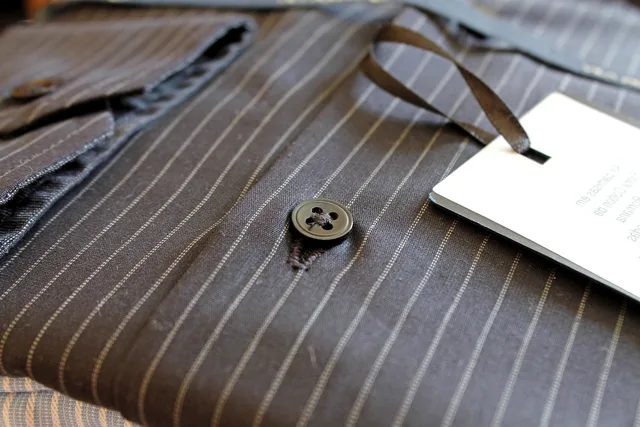
- Pattern across seams.On a stripe or a check, follow the pattern from the body across the sleeve head and across the center back. Where it continues, someone cut carefully. Where it jumps, they saved cloth.
- Buttonholes and buttons.Dense, tidy stitching with no loose threads; buttons attached with a shank of thread so they can be fastened without straining the cloth.
- The sleeve pitch.Hang the jacket and look from the side. The sleeve should hang forward slightly, following the natural rest position of the arm. A sleeve that hangs straight down will show a diagonal drag line as soon as it is worn.
None of this requires expertise. It requires putting your hands on the garment and looking at it for longer than the shop expects.
Cloth, and how to tell what it will do
The cloth is what you live with, and the two things to establish are weight and hand.
Weight is what you feel holding the jacket by the shoulders at arm's length. A cloth with substance hangs straight and pulls the jacket into shape under its own mass. A very light cloth floats and creases at every fold.
Hand is the feel between finger and thumb. A dry, papery cloth will crease like paper. A cloth with a little spring in it will recover from a day in a chair.
By law, fiber content sits on a label, and it is the most under-read line on the garment. The FTC's guide to labeling requirements under the textile and wool acts explains what the label must disclose and how.
Read it as a specification: it predicts how the cloth will crease, pill, breathe and respond to cleaning. A photograph cannot give you that evidence.
Trousers hang from the waist
A trouser has two jobs: hang from the waist without tension, and end in the right place over the shoe. Everything in between is cloth.
The waist is the seam to buy for. It should sit closed without the belt holding it; a belt finishes, it does not fasten. If the waistband must be held shut, the seat and thigh pull with it, and pockets gape.
Check the center back seam inside. The spare cloth there is how much the waist can be let out, and a well-made trouser gives plenty.
Length is the cheapest alteration there is and the one most often skipped. Decide how much of the trouser front should rest on the shoe, and have it hemmed to that. Worn at the shop's length, a trouser is usually wrong by an amount that shows at distance and costs almost nothing to fix.
The shoe underneath is the fixed point in that decision, unless the job puts a hazard under the foot. Then the specification comes from the employer's assessment under the foot protection standard rather than from the trouser.
The shirt is a set of numbers
A dress shirt is sold by neck and sleeve, and those numbers are honest. Buy the neck so that two fingers fit inside the fastened collar. Buy the sleeve so that the cuff stops at the wrist bone with the arm hanging; it will ride up when you bend the elbow, and it should.
The numbers do not cover the body cut, from full to close, or the collar construction. That collar decides whether the shirt was built for a tie or without one.
A collar with a stiff interlining and a high stand is engineered around a knot. Once the tie is gone, the register problem is covered in the guide to business casual for men. It is why a formal shirt worn open never looks like a casual shirt.
Selection criteria in one list
For any garment, in this order:
- Fixed points fitshoulder and chest on a jacket, waist on a trouser, neck on a shirt.
- Construction passes the hand testa floating chest layer, a rolling lapel, matched pattern, sound buttonholes.
- Cloth has weight and recovers; the fiber label agrees with what your hand told you.
- The remaining fit is within routine alteration, and the alteration is counted as part of the price.
- The garment belongs to the register of the room it is for. A jacket built to be a suit will not be a sports jacket whatever it costs.
Where the building's expectations sit on that last point is a separate question. The way the wider profession dresses is set out from the other side in women's professional wear, whose planning method transfers directly even where the garments do not.
Common questions
Is a fully constructed jacket always better than a glued one?
For longevity and for how it ages, yes. For a jacket that will be worn rarely and replaced rather than cleaned, the difference matters less. Know which you are buying, because the price does not always tell you.
How much alteration is too much?
If the shoulder or chest needs work, all of it is too much. If the work is sleeves, waist and hem, the garment was a good buy and the alteration is the last step of buying it.
Should the trouser and jacket always match?
Only when cut from the same cloth at the same time are they a suit. Two garments that nearly match read as a mistake; two that clearly differ read as a choice.
The same reasoning applies to the whole outfit in business casual for women, where the range of garments is wider and the decision arises more often.
What about the fiber label on a blended cloth?
Read the percentages. A small share of a synthetic fiber in a wool cloth can improve recovery and hard wear; a cloth that is mostly synthetic will behave like the synthetic, whatever the first word on the label is.
In this guide
- Men's professional wear: alterations to pay for, in orderMen's professional wear fits through alterations: which five to pay a tailor for, in what order, how to brief the tailor and what a seam allowance allows.
- The care mistakes that quietly ruin men's professional wearMen's professional wear mistakes made in care rather than in wear: washing, dry cleaning, pressing and storage faults, and what each does to cloth.
- Men's professional wear trends 2027: five that will lastMen's professional wear trends 2027: softer jackets, year-round cloth, the outer layer, the optional tie and camera-safe cloth, and the cycles to rent, not buy.
- How to inspect men's professional wear twice a year: four wear points and what to fix, demote or replaceA twice yearly inspection of men's professional wear: the four places that wear first, storage damage, and what to fix, clean, demote or replace.
- How to sort a professional wear listing into specifications and descriptionA method for reading a professional wear listing, separating verifiable specifications from marketing description, and testing a garment yourself over time.
- 6 things nobody tells you about men's professional wear examplesFive men's professional wear examples of common fit faults, with the causes behind each symptom, the test that identifies it, and the possible remedy.