Industry
Part of Men's professional wear: what to check in the jacket, cloth, trouser and shirt
How to sort a professional wear listing into specifications and description
A method for reading a professional wear listing, separating verifiable specifications from marketing description, and testing a garment yourself over time.
A garment listing is mostly language, and the language divides cleanly into two kinds. Some of it is a specification, which is verifiable and comparable. The rest is description, which is neither. Learning to sort a listing into those two piles is the closest thing to a reliable review method there is.
This page is about reading claims rather than trusting verdicts. It applies to a maker's own copy, to a magazine roundup, and to a stranger's post, because all three are made of the same two kinds of sentence.
What to take away
- A specification is a number, a fiber name, or a construction term with a fixed meaning. Everything else is description and cannot be compared between garments.
- The absence of a specification is itself information. Makers publish what flatters them.
- A review can tell you what happened to one garment on one body. It cannot tell you what will happen on yours, and no amount of detail closes that gap.
The two piles
| Specification | Description |
|---|---|
| Fiber content by percentage | "Premium", "luxury", "heritage" |
| Cloth weight, stated in grams per square meter or ounces per yard | "Substantial", "midweight feel" |
| Weave or knit name: twill, poplin, oxford, pique, jersey | "Breathable", "structured" |
| Lining fiber and whether it is full or half | "Fully finished interior" |
| Flat measurements: chest, waist, shoulder, sleeve, length | "True to size", "modern fit" |
| Construction terms with settled meanings: canvassed, fused, bar tack, curtained waistband | "Expertly tailored" |
The left column can be checked against another garment. The right column cannot be checked against anything, including itself.
Specification vs Description
Specification
- Fiber content
- Percentages
- Cloth weight
- gsm or oz/yd
- Weave
- Twill, poplin, oxford
- Lining
- Fiber, full/half
- Flat measurements
- Chest, waist, shoulder
- Construction
- Canvassed, fused
Description
- Fiber content
- Premium, luxury
- Cloth weight
- Substantial, midweight
- Weave
- Breathable, structured
- Lining
- Fully finished interior
- Flat measurements
- True to size, modern fit
- Construction
- Expertly tailored
What the specifications actually predict
Fiber content predicts behavior more reliably than anything else on a label. The FTC guidance on labeling under the textile and wool acts lists what that statement must disclose, including generic names and their order.
What Specifications Predict
Specification
- Fiber content
- Behavior
- Weight
- Season and drape
- Weave name
- Surface and wear
- Flat measurements
- Fit
Predicts
- Fiber content
- Most reliable
- Weight
- Often omitted
- Weave name
- Checkable by eye
- Flat measurements
- Compare to own garment
Read percentages, not blend names. A small fiber percentage changes marketing more than it changes the cloth.
Weight predicts season and drape. It is the specification most often omitted, and its absence usually means the cloth is lighter than the photographs suggest. Two garments of identical fiber content and very different weights are different garments.
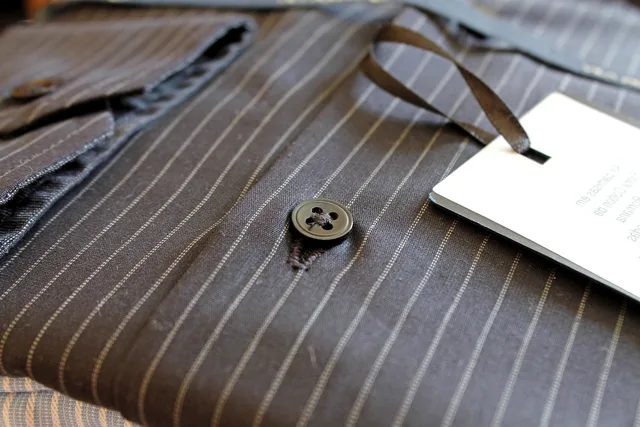
Weave name predicts surface and wear. A twill shows a diagonal and resists creasing; a plain weave shows none and creases more. This is checkable by eye once you know to look, which makes it one of the few claims you can verify yourself in a store.
Flat measurements predict fit, and a size label predicts nothing. The measurement to compare is not your body but a garment you already own and like, measured flat on a table. That comparison survives across makers, across countries and across decades.
Claims that sound like specifications and are not
"True to size" is a claim about the reader, not the garment. "Tailored fit" and "modern fit" are the maker's internal names for their own patterns and mean different things at different makers, sometimes at the same maker in different years.
"Wrinkle resistant" is a real treatment with a real effect and no stated magnitude, so it tells you a direction and not a result. "Performance fabric" names no fiber and no finish. "Handmade" describes a step, not the garment; almost every garment has some handwork.
The most useful response to any of these is to look for the specification it is standing in for. If none is given, assume the specification is unflattering.
Testing a garment yourself
A review you run is worth more than one you read, because the body is yours. Keep it short and write it down.
Test a Garment Yourself
- Wear full working day, note binding
- Sit an hour, stand, photograph creasing
- Clean once by label, compare photo
- Wear ten times, check four wear points
- Wear the garment for a full working day, not an evening. Note where it binds during the day rather than at the end.
- Sit for an hour and then stand and photograph yourself. Creasing that recovers within a minute is not a problem; creasing that stays is the cloth telling you what it is.
- Clean it once by the label's stated method, then compare against a photograph taken before. Most bad surprises happen on the first clean, and the label's method is the one the maker has to stand behind under the rules on care labeling of textile wearing apparel.
- Wear it ten times, then look at the four wear pointscollar, underarm, seat, cuff.
Four data points and a month gives you a better answer about that garment than any published review, and it gives you a comparison you can reuse on the next purchase.
What a review genuinely cannot do
It cannot tell you about fit, because fit is a relationship between a pattern and a body and the reviewer has a different one. It cannot tell you about durability in under a year. It cannot tell you whether the line you are buying today is the line that was reviewed, because makers change factories without changing names.
A construction check on the garment in your hands beats a recommendation about the maker. The softer end of the wardrobe is covered in business casual for men.
The order for judging a garment once it arrives is in men's professional wear. The same reading for footwear, where specifications differ, is in work shoes.
Where the garment is required rather than chosen, the specification comes from the employer's hazard assessment instead of from a maker's copy, and that distinction is drawn in the guide to industry dress codes. And a garment that has to work in a photograph has one more criterion that no listing mentions, covered in the guide to headshots and presentation.
Common questions
Is a detailed listing a sign of a good garment?
It is a sign of a confident maker. That correlates, weakly. A short listing with a stated weight and full flat measurements is more useful than a long one with neither.
How do I compare weights when makers use different units?
Convert once and keep the note. Grams per square meter and ounces per yard both describe the same property, and once you know the weight of two garments you already own, every new number becomes readable.
Are user reviews worth reading at all?
For failure modes, yes. A pattern of the same complaint across many reviews is real information. Averages and star ratings are not, because they mix people with different bodies and different expectations into one number.
What if a maker publishes no specifications at all?
Then the garment has to be judged in the hand, or bought against a returns policy that lets you judge it in the hand later. There is no third option.