Reviews
Part of Men's professional wear: what to check in the jacket, cloth, trouser and shirt
Men's professional wear: alterations to pay for, in order
Men's professional wear fits through alterations: which five to pay a tailor for, in what order, how to brief the tailor and what a seam allowance allows.
Fit is the one thing you can buy after the fact. A garment that fits looks deliberate at any price, and no fabric, finish or label rescues one that does not. The useful question for a small budget is which alterations to pay for, and in what order.
What to take away
- The shoulder is the only fitting point you cannot fix cheaply. Buy for the shoulder and alter the rest.
- Five alterations do the work, ranked by visible differencetrouser hem, jacket sleeve, trouser taper, shirt body and jacket waist.
- Ask what seam allowance a garment has before assuming a change is possible.
- Bring the shoes and the shirt you will wear, and judge the pinned line before you agree to anything.
- Spend on alterations for what you wear weekly, and read fiber content instead of yarn count.
The shoulder sets the limit
The shoulder is the boundary of what alteration can do. The seam where the sleeve joins the body should sit at the edge of your shoulder, where the flat part turns and slopes. Every alteration below assumes that point is right.
If the seam hangs past that point, the sleeve head lacks support and a diagonal ripple forms below. If it stops short, the fabric pulls and the whole panel twists as your arm moves. Recutting a shoulder means detaching the sleeve, reshaping the padding and canvas, and reattaching it. That is a rebuild rather than an adjustment, so question it closely before you agree.
The same principle applies to a coat and, in a weaker form, to a shirt. A shirt seam sitting halfway down the upper arm still puts the sleeve at the wrong angle, and taking in the body will not correct it. How to judge a jacket before you buy it is covered in men's professional wear.
Five alterations, ranked by visible difference
Once the shoulder is right, most of the remaining fit is adjustable, and the work is routine rather than skilled. The table ranks the changes by how much visible difference each one makes.
| Alteration | What it fixes | Notes |
|---|---|---|
| Trouser hem and length | Fabric pooling over the shoe, or an unintended gap at the ankle | The most common single fault and the cheapest to fix |
| Jacket sleeve length | Sleeves swallowing the hand, or ending above the wrist bone | Simple from the cuff; more involved if the sleeve has working buttonholes |
| Trouser taper below the knee | A leg cut much wider than the shoe it sits over | Small change, large effect on how the whole line reads |
| Shirt body taken in at the side seams | A shirt that balloons at the waist when tucked | Turns a boxy off-the-rack shirt into something that looks made for you |
| Jacket waist suppression | A jacket that hangs straight when it should follow the body | Possible on most jackets, limited by how much seam allowance was left |
Ask what seam allowance a garment has before assuming a change is possible. Cheaper manufacturing leaves less spare fabric inside the seam, which is one of the real differences between price tiers and one nobody advertises. Turn the garment inside out and look.
Work down the table in order. Start with the trouser hem, since it is the cheapest to fix and the most common single fault. Move to the sleeve and the taper once the first change shows you the line you want. Leave the shirt body and the jacket waist until the garments you wear weekly have had the first three.
Why menswear alterations are routine
Menswear has an advantage: standard alterations are common, routine and understood the same way by most people who do them. Hems, sleeves and side seams are predictable on a garment whose construction is broadly standardized.
Women's tailoring is less standardized. Its cut and construction vary more, so the same nominal change asks more of the person doing it. The construction behind that variation, from darts to princess seams to vents, is set out in how women's professional wear is built.
The practical consequence for a small budget is a shift in where the money goes. Rather than hunting for the garment that fits slightly better off the rack, buy the one with a correct shoulder and have three things adjusted. The result reads better.
Brief the tailor and read the pins
The work itself is routine, and the briefing is what decides the result. Use this order at the fitting:
- Bring the shoes you will wear with the trousers and the shirt you will wear under the jacket.
- Put the garment on and let the tailor pin it.
- Look at the pinned line in the mirror before you agree to anything, because the pins are what you are actually buying.
- Ask what they would change, what they would leave alone and when the work will be ready.
- On a jacket, ask whether the sleeve can be shortened at the cuff or has to come off at the shoulder, and whether the sleeve buttons are working or decorative.
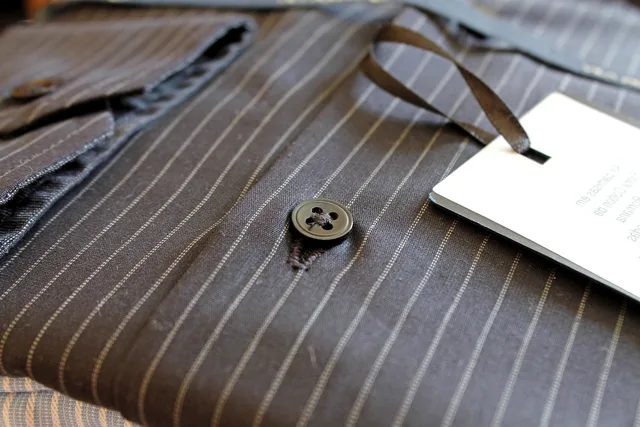
The last question matters because working buttonholes set how much can come off the sleeve without moving the buttons up toward the elbow.
For finding a shop, start with whoever does the alterations for the store that sold you the garment, or with a dry cleaner that handles better clothing. If the answer to a shoulder question is a recut, ask what it involves, and treat the estimate as a reason to consider a different garment instead.
Where the alteration budget goes first
Alterations on everything worn weekly give the most visible improvement for the money. One jacket that fits properly is more useful than three that nearly do. Shoes come next, because they take the most wear.
- Alterations on everything worn weekly.The most visible improvement available.
- One jacket that fits properly.More useful than three that nearly do.
- Shoes.The difference between a resoleable construction and a glued one shows up in the second year, not the first. The work shoes guide goes into what to look for. Where the job puts a hazard under the foot, the choice stops being a wardrobe decision: the footwear comes from the employer's assessment under OSHA's foot protection standard, 29 CFR 1910.136, and the shoes themselves carry a rating under ASTM F2413.
Skip extra shirts beyond what a week needs, anything with a finer yarn count than the job requires, and novelty. Finer yarn is not a durability upgrade. It produces a lighter, smoother cloth that creases and wears through faster, a reasonable trade for occasional formal use and a poor one for daily wear. The formal end of the wardrobe is covered in business formal.
No label has to state a yarn count. The fiber content does, disclosed under the Textile Fiber Products Identification Act rules of the FTC, which makes it the more reliable thing to read. The everyday end of that decision is covered in business casual for men.