Reviews
Part of Men's professional wear: what to check in the jacket, cloth, trouser and shirt
6 things nobody tells you about men's professional wear examples
Five men's professional wear examples of common fit faults, with the causes behind each symptom, the test that identifies it, and the possible remedy.
What to take away
Men's professional wear examples fail in predictable ways. Almost every complaint about a garment is a symptom with more than one possible cause. The causes have different remedies.
A Brooks Brothers Regent jacket that pulls at the button might be too small, or it might be the right size cut for a different posture. One of those is fixable and one is not.
What follows is six worked examples: the visible symptom, the ways it is produced, and the test that tells you which one you have. They are the failures that come up most often in a fitting room and get diagnosed wrong most often.
- A symptom is not a diagnosis. The same wrinkle can mean too small, wrong shape, or correct garment worn wrong.
- Wrinkles point at the problem. Diagonal drag lines run away from the place where the cloth is short.
- Test each case standing relaxed, in a mirror, without adjusting anything. The instinct to tug is what hides the evidence.
Example one: The Brooks Brothers Regent suit jacket and its three fit faults
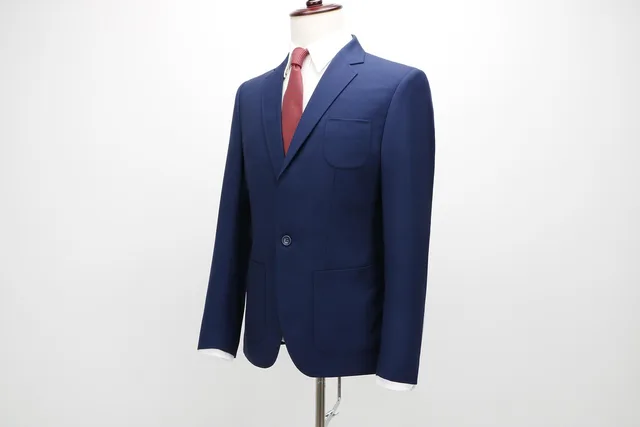
The Brooks Brothers Regent is a trim-cut suit jacket. It sits close through the chest and waist. That cut produces three faults that get blamed on the wrong cause.
The symptom is an X of wrinkles radiating from the fastened button.
Cause A: too small through the chest or waist. Cause B: chest fits, but the button sits at the wrong height for your torso, so the closure pulls against your widest point. Cause C: the jacket is cut for a flatter posture than yours, producing the same X plus a gap at the back of the collar.
The test: unfasten the button and look at the front edges while standing relaxed. If they hang parallel with a hand's width of overlap available, the chest is fine and the problem is button height or posture. If they hang apart, the jacket is small.
The remedy: button height can be moved. Chest cannot be added. Posture is a pattern problem and belongs to a different garment.
The collar that stands away from the neck
The symptom is a visible gap between the jacket collar and the shirt collar at the back.
Cause A is a jacket sitting too far back because the shoulders are too wide. Cause B is a posture with more curve at the upper back than the pattern assumed, which pushes the collar off. Cause C, the trivial one, is a shirt collar that is too tall for the jacket.
The test: have someone press the jacket collar gently against your neck. If the front then hangs correctly, it is a collar adjustment. If the front lifts or the sleeves change, the shoulders are wrong.
The remedy: a tailor can shorten a collar. Shoulders are the expensive alteration and usually the point at which the garment is the wrong garment, which is why shoulder fit leads the order of decisions in men's professional wear.
The sleeve that swallows the cuff
The symptom is a jacket sleeve covering the shirt cuff entirely, so the arm ends in a single block of jacket cloth.
Cause A is a jacket sleeve too long. Cause B is a shirt sleeve too short. Cause C, more common than either, is a jacket whose sleeve is correct but whose shoulder is too wide, dropping the whole sleeve down the arm.
The test: measure nothing. Stand with arms relaxed and check where the jacket sleeve ends against the wrist bone, then push the jacket sleeve up and check the shirt separately. Two garments, two judgments.
The remedy: both sleeves shorten cheaply. The shoulder does not, and this is the third example on this page where the shoulder turns out to be the real answer.
Example two: The Charles Tyrwhitt dress shirt that balloons at the waist
The Charles Tyrwhitt dress shirt is sold by neck size and sleeve length. Many of its cuts run straight through the body. That is why the shirt can fit the neck and still swell at the middle.
The symptom is a shirt that fits at the neck and shoulders and then swells at the middle, showing under a jacket and above a waistband.
Cause A is a shirt cut straight through the body. Many shirts are sized by the neck alone.
Cause B is a shirt that fits but has been tucked badly.
Cause C is a shirt that has been laundered hot and shrunk in length but not in width. There is less shirt above the waistband holding it down.
The test: tuck the shirt properly, arms down, and turn sideways in the mirror. If the excess sits in one column at each side seam, it is cut and can be taken in. If it bunches unevenly all around, look at the length.
The remedy: side seams are the cheapest alteration on a shirt and the one that changes the most. Length cannot be added back.
Example three: The Bonobos Weekday Warrior dress trousers that twist along the leg
The Bonobos Weekday Warrior is a dress trouser sold in slim, straight, and athletic fits. A twist in the leg is not usually a fit problem. It is usually a cutting problem.
The symptom is a seam that spirals slowly around the leg instead of falling straight down.
Cause A is a cutting fault: the cloth was cut off grain, and the garment will twist for its whole life. Cause B is a leg that is simply too narrow for the thigh, so the cloth is forced around. Cause C is laundering, where a cloth with a mechanical finish has relaxed unevenly.
The test: lay the trouser flat on a table, front creases aligned, and look at the inseam. If it will not lie flat on the table, it was cut wrong.
The remedy: none for cause A. This is the only case where a return is the only answer.
Cause B is a fit question, sometimes helped by going up a size and tapering. Cause C sometimes improves with pressing. The label under the FTC care labeling rule tells you what treatment the maker will stand behind.
Example four: The Hermès silk necktie that swings away from the shirt collar
The Hermès silk tie is cut on the bias and typically sells for around $200 to $250. A tie that swings away from the shirt collar is not always a knot problem. The cause can be the tie, the collar, or the shirt.
The symptom is a tie blade that stands off the shirt instead of lying flat against it.
Cause A is a tie that is too wide for the collar spread. Cause B is a collar that is too wide for the knot, so the knot slips down. Cause C is a shirt that is too tight at the chest, pushing the tie forward.
The test: knot the tie, stand relaxed, and look at the side. If the blade touches the shirt below the knot and only the knot stands off, the collar spread is the issue. If the whole blade floats, the tie width or shirt chest is the issue.
The remedy: a tie bar holds the blade against the shirt. A different knot can fill a wide collar. A tailor can take in a shirt chest, but that is rarely worth the cost on a ready-made shirt.
Example five: The Trafalgar leather dress belt that gaps at the waistband
The Trafalgar leather belt is sized by waist and typically sells for around $100 to $150. A belt that gaps at the waistband is usually the wrong length, not the wrong style.
The symptom is a belt that sags below the waistband or leaves a gap above the trousers.
Cause A is a belt that is too long, so the buckle sits off center. Cause B is a belt that is too wide for the loops, so it cannot sit flat. Cause C is trousers with a low waistband and a belt worn on the wrong hole.
The test: fasten the belt on the middle hole and look in the mirror. The buckle should sit just left or right of center, and the belt should touch the waistband all the way around. If the tail hangs past the first loop, the belt is too long.
The remedy: a cobbler can punch a new hole for a few dollars, but that only fixes length. A belt that is too wide needs a different belt. The middle hole is the one to use, so the belt has room to move after a heavy meal.
Example six: The Allen Edmonds Park Avenue oxford that slips at the heel
The Allen Edmonds Park Avenue is a cap-toe oxford with a leather sole. It is a common professional dress shoe. Heel slip is normal in the first few wears. A slip that stays after break-in is a fit fault.
The symptom is a heel that lifts out of the shoe with every step.
Cause A is a shoe that is too long. Cause B is a shoe that is too wide. Cause C is a low instep, so the shoe cannot lock the heel. Cause D is a thin sock that changes the volume.
The test: walk on carpet, not concrete. If the heel lifts more than a quarter inch, the shoe is too long or too wide. If the heel stays down but the shoe pinches across the instep, the size is wrong in a different way.
The remedy: try a half size down, then a narrower width. A tongue pad can take up volume on a low instep. Thicker socks can help, but they are a workaround. A shoe that slips after break-in will usually keep slipping.
The pattern under the six
Four of the five garment faults described above are diagnosed by looking somewhere other than where the symptom appears. That is the transferable lesson: the wrinkle is downstream of the fault, and the fault is usually above it, at the shoulder or the neck.
The necktie, belt, and shoe follow the same logic. The tie gap points at the collar or chest. The belt gap points at the waistband or belt length. The shoe slip points at length, width, or instep volume.
The second lesson is that the cheap alterations are all below the widest point of the garment. Sleeves, hems, side seams and tapers are routine. Anything that touches the shoulder or the chest is not.
The value calculation around that is worked through in the guide to business casual for men. Shoes carry the same diagnostic logic, but wear patterns rather than wrinkles hold the evidence. That is in the guide to work shoes. The formal end of the range, where these faults are least forgiving, is covered in business formal.
Where a garment is issued rather than chosen, none of this is yours to fix, and the employer's obligation to select equipment that fits the worker is part of the OSHA general requirements for personal protective equipment. The sectors where that applies are described in the guide to industry dress codes.
Common questions
Should I trust a salesperson's diagnosis?
Trust the test, not the verdict. Ask them to show you what they are seeing and check it yourself in the mirror. A good one will do this happily.
Do these faults get better with wear?
Cloth relaxes and a garment settles. That improves a slight tightness and does nothing for a fault in the cut. If a garment is uncomfortable in the shop, it will be uncomfortable in six months.
Is a fitting service worth paying for?
For a first tailored garment, often yes, because you learn the vocabulary. After that the value drops fast, since the same six faults account for most of what you will ever see.
What if two causes are present at once?
Common, and it is why the tests above isolate one variable at a time. Fix the one nearest the shoulder first and re-look, because it frequently takes the second symptom with it.