Guides
Business Casual for Humid Climates: Fabrics That Actually Breathe
Business casual for humid climates starts with what you remove: lined jackets, tight weaves, and cotton that holds sweat. Then choose open weaves.
What to take away
- Open-weave linen, lightweight wool and cotton-linen blends still work for business casual in humid US summers, where fabric choice matters more than fit, brand or price.
- The hard limit rules out lined wool suiting and tight synthetic blends.
- A workaround stops paying when you sweat through a shirt before 10 a.m. more than twice a week.
- At that point, add breathable pieces or change your commute schedule instead of buying more of the same.
The Gulf Coast and Southeast do not just run hot. They hold moisture in the air from May through September, and that changes what you can wear to an office. If you need to rebuild a small rotation around fewer pieces, affordable business casual women explains the capsule arithmetic that works.
The limit in measurable terms
The constraint is a dew point at or above 70 F for three to four months, with a heat index above 95 F on most afternoons. It applies to one person with a 15 to 20 minute outdoor walk, no car cooling between stops, and no tailor on call.
That limit rules out full-lined jackets, polyester dress shirts, heavy cotton twill and silk ties. A fabric that holds sweat against skin is not business casual in this climate, no matter how sharp it looks on a hanger.
What the constraint removes
The table below shows how common choices behave at a 75 F dew point.
Fabric behavior at 75 F dew point
Linen
- Moisture
- Moves, dries fast
- Odor
- Neutral
- 20 min walk
- Works
- Verdict
- Works if wrinkles ok
Lightweight wool
- Moisture
- Manages
- Odor
- Resists
- 20 min walk
- Works open weave
- Verdict
- Works open weave
Cotton poplin
- Moisture
- Holds, dries slow
- Odor
- Holds
- 20 min walk
- Fails
- Verdict
- Fails
Polyester blend
- Moisture
- Traps heat
- Odor
- Traps
- 20 min walk
- Ruled out
- Verdict
- Ruled out
| Fabric | Typical weight or blend | Behavior at a 75 F dew point |
|---|---|---|
| Open-weave linen | 5 to 6 oz | Wicks fast, dries in open air, wrinkles |
| Tropical wool | 7 to 8 oz, plain weave | Holds its shape, breathes through the weave |
| Cotton-linen | About 55/45 | Softer than pure linen, dries a little slower |
| Cotton poplin | 4 to 5 oz, dense | Feels cool at first, then sticks |
| Polyester dress shirt | 3 to 4 oz | Traps sweat and odor |
| Heavy cotton twill | 8 to 10 oz | Too dense for a 20 minute walk |
| Lined wool suiting | 9 oz and up, plus lining | Unsuitable outdoors in August |
What still works
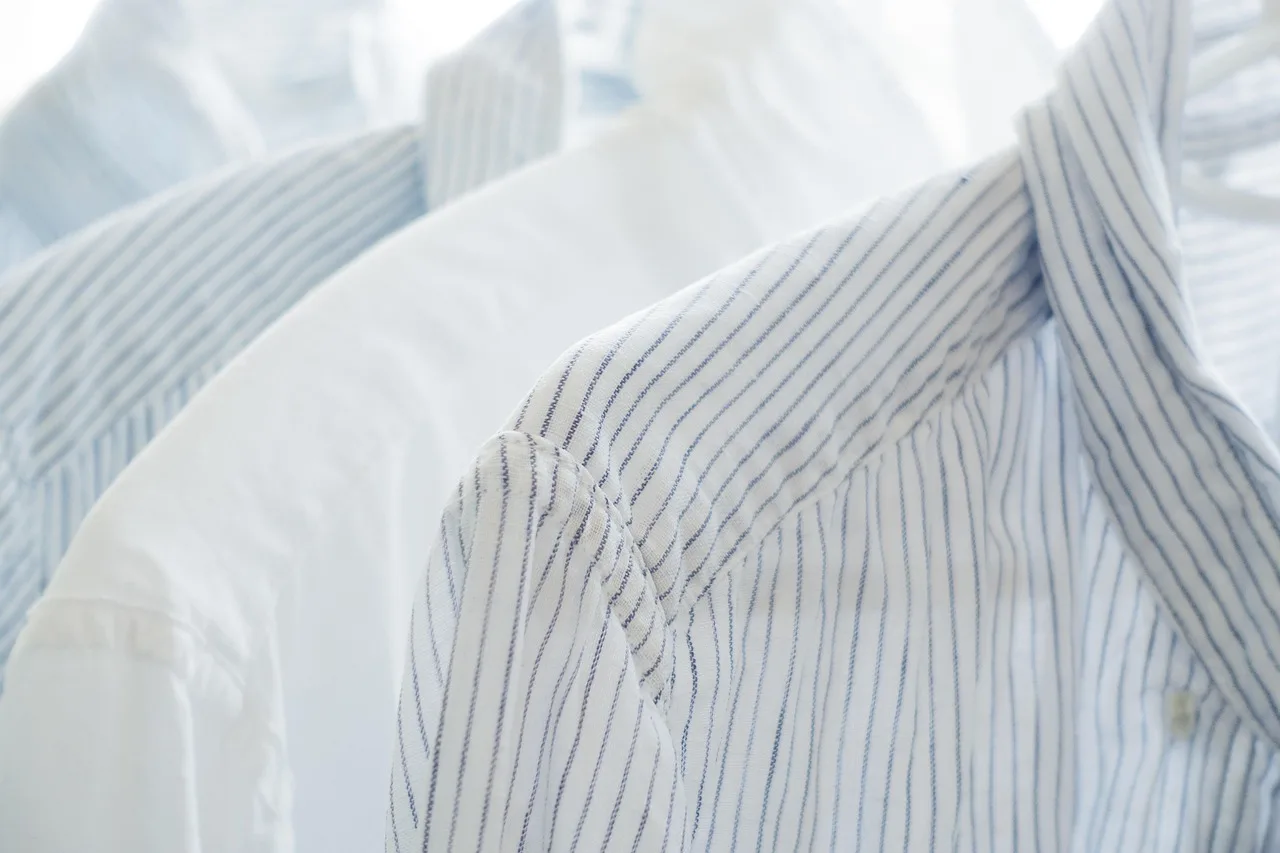
Open weaves are the answer. A linen shirt with a relaxed collar, a tropical wool trouser, or a cotton-linen blend will dry faster than a tight poplin. Linen handles moisture well, and cotton feels comfortable in warm, humid conditions when the weave is not dense.
Weight matters as much as fiber. Summer tropical wool is typically 7 to 8 oz per square yard, and a workable cotton-linen shirt usually sits near a 55/45 blend. Most suiting above 9 oz is too heavy for a humid commute, lining included.
Air movement does much of the drying, so a loose weave in a breezy lobby beats a tight one in a still cubicle.
The same logic applies to men who wear the same three shirts on rotation. affordable business casual men covers what to keep and what to drop.
Compromises worth making
A breathable shirt with a pressed collar reads more professional than a heavy jacket that leaves you damp.
Compromises worth making
- Switch to unlined or half-lined jacket
- Choose looser cut through chest and arms
- Carry second shirt in breathable tote
- Walk outdoors before 9 a.m. or after 6 p.m.
- Keep small towel in bag for lobby
Compromises that are not
A tailored wool suit with a full lining is ruled out for a 20 minute outdoor commute. The same goes for a polyester performance polo with a company logo, which traps heat and reads more casual than business casual in most US offices.
Do not solve humidity by removing the undershirt. A thin cotton undershirt absorbs sweat and protects the outer shirt.
When to stop and resource it properly
The workaround stops paying when the heat index passes 103 F, or when you sweat through a shirt before 10 a.m. more than twice a week. Three weeks of fabric swaps without relief is another sign.
At that point, spend on two breathable shirts or one half-lined jacket instead of ten cheap ones. If the workaround still fails, business formal checklist helps you rebuild around a few reliable pieces instead of adding more compromise.
Example: Houston commute at 76 F dew point
A paralegal walks four blocks from a parking garage to a downtown office. Her checklist for August:
Houston August commute checklist
- Linen-cotton shirt with relaxed collar
- Lightweight wool trousers with unlined waistband
- Unlined blazer carried, not worn
- Leather shoes with moisture-wicking socks
- Second shirt in breathable tote
Houston commute at 76 F dew point
- A cotton-linen shirt, near a 55/45 blend, with a relaxed collar.
- A thin cotton undershirt.
- A half-lined tropical wool blazer, typically 7 to 8 oz, carried over one arm.
- A spare shirt for the restroom change.
- A small towel and a bottle of water.
She changes shirts in the restroom, hangs the blazer at her desk, and keeps the first shirt in a plastic bag. OSHA's heat illness prevention page notes that clothing and fabrics matter in hot, humid environments, which is why she carries the blazer instead of wearing it.