Reviews
Women's professional wear: a weekly wardrobe plan
A women's professional wear weekly plan with sample Monday-to-Friday outfits, plus a practical grid for matching anchors, tops, layers, and shoes.
To plan women's professional wear, take everything you wear to work and put it on the bed. Not the things you like, the things you actually wear. Then stand back far enough that you cannot read a label.
That is the whole method of this page. Most wardrobe advice is written at the scale of the single garment, and the single garment is not what anyone sees.
A room sees an outline, a level of contrast and a line, from several meters away, for a few seconds, and it repeats the exercise every day of the week. Planning at the scale the room uses is what makes a wardrobe look deliberate.
What to take away
- Plan the week, not the outfit. A working wardrobe is a grid where every bottom half pairs with every top half, and a garment that only works in one combination is a cost, not a choice.
- What reads at distance is silhouette, contrast and line. Color and print are noticed last and forgotten first.
- The size on the label is not a measurement. Treat alteration as part of the purchase rather than as a repair, and buy on the seam that cannot be changed.
Lay it out where you can see it
Sort the pile into four rows: anchors (trousers, skirts, dresses), tops, layers (jackets, cardigans, anything that goes over), shoes. Now walk the rows.
Wardrobe Grid Pairing Check
- Every anchor works with every top
- Every layer closes over every top
- No pulling at the shoulder blade
- Every shoe sits under two anchors
- Fix the grid before buying anything
Every anchor must work with every top, and every layer should close over every top without pulling at the shoulder blade.
Every pair of shoes should sit under at least two anchors. A garment that fails those pairings will sit in the wardrobe unworn. You already know which ones they are, because they are the ones you did not put on the bed.
The exercise usually produces three findings.
There are more tops than anchors. That is why mornings feel like nothing to wear when plenty is there. One layer goes over everything, and one goes over nothing.
Shoes split into the pair worn four days a week and pairs kept for a day that does not come.
Fix the grid before buying anything.
A second anchor in a color that takes every top you own does more for the week than four new tops, and it costs less.
The smaller-wardrobe argument in business casual for women makes the same case, and it applies with more force here. The range of garments is wider, and the chance of buying an orphan is higher.
What a room reads from across it
Stand at the far side of a meeting room and look at the people in it. You cannot see fabric quality. You cannot see a print. You can see three things.
What the Room Sees
Visible at distance
- Silhouette
- Close vs loose, waist position
- Contrast
- Tone gap top vs bottom
- Line
- Hems, sleeves, jacket front
What produces it
- Silhouette
- Chosen or happened
- Contrast
- Where the eye is pulled
- Line
- Whether anything is out of place
What it tells the room
- Silhouette
- Contrast
- Line
| What is visible at distance | What produces it | What it tells the room |
|---|---|---|
| Silhouette | Where the garment is close and where it is loose, and where the waist of the outfit sits | Whether the clothes were chosen or happened |
| Contrast | The gap in tone between top half and bottom half, and between the outfit and the skin | How much the eye is pulled, and to where |
| Line | Hems, sleeve ends, the vertical of a jacket front, the shoulder | Whether anything is out of place |
Silhouette is set mostly by fit, and fit is dealt with below. Contrast is a choice you make in the grid: a wardrobe built on low contrast reads as calm and one built on high contrast reads as emphatic, and neither is wrong, but mixing them at random reads as neither.
Line is the one that betrays a bad morning. A hem that dips, a sleeve that stops at the wrong place, a jacket front that gapes when buttoned. All of them are visible from across the room, so check them before you leave home.
The order matters. People shop for color and print, the two things the room registers last, and neglect fit and line, the two things it registers first.
The week is the unit
A morning is a bad time to make decisions and a week is a good one. Once the grid works, the plan for a week is a list of days, each with one thing that has to be true.
Five Days, Five True Things
- Desk daycomfort over six hours sitting
- Client or boardone notch more structure
- On cameraneckline and shoulder do the work
- Out on footshoes for distance, rain-ready layer
- Presentingnothing that has to be adjusted
| Shape of the day | What has to be true |
|---|---|
| Desk, meetings, nobody external | Comfort over six hours of sitting; the layer can come off and go back on |
| A client or the board in the building | One notch more structure than the ordinary day; shoes in good condition |
| On camera for most of it | The neckline and the shoulder do all the work; nothing that shimmers |
| Out of the building, on foot, in weather | Shoes for the distance; a layer that survives rain without changing what the outfit is |
| Presenting or standing in front of people | Nothing that has to be adjusted; you will not have a hand free |
A sample Monday-to-Friday plan
This sample uses three mix-and-match anchors (two pairs of trousers and a skirt), one standalone dress, three tops, two layers, and two pairs of shoes. Assume each top and layer works with each mix-and-match anchor; plan the dress as its own outfit.
- Monday — Desk and meetings:
- charcoal trousers, pale blue blouse, gray cardigan, and black loafers.
- Tuesday — Client or board:
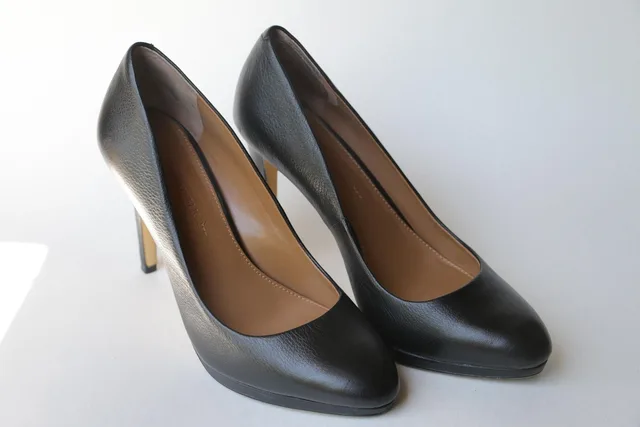
- charcoal skirt, white blouse, navy jacket, and black pumps.
- Wednesday — On camera:
- navy trousers, solid burgundy top, navy jacket, and black pumps.
- Thursday — Out of the building:
- charcoal trousers, white blouse, gray cardigan, and black loafers.
- Friday — Presenting:
- navy dress, navy jacket, and black pumps.
Treat these as example combinations, not a shopping list. Substitute pieces you already own if they meet the needs of the day and work with the rest of your grid.
Use the sample as a starting point, then assign garments from your own grid to satisfy each day's requirement. The plan can repeat from week to week; well-assembled combinations seen consistently are what competence looks like from the outside.
The size on the label is not a measurement
This mechanical fact shapes everything else on this page: women's garments are sold by a size number. That number means something different in every maker's range and drifts within one range over the years.
Fixed vs Negotiable Fit
Fixed seams
- Shoulder seam
- Fixed
- Armhole
- Fixed
- Bust dart
- Close to fixed
- Hem
- Negotiable
- Sleeve length
- Negotiable
- Trouser waist
- Negotiable
Negotiable with a tailor
- Shoulder seam
- Narrowing: skilled, costly
- Armhole
- Reshaping: skilled, costly
- Bust dart
- Position: limited
- Hem
- Routine and cheap
- Sleeve length
- Routine and cheap
- Trouser waist
- Routine and cheap
Men's tailoring is sold by measurement: chest, neck, sleeve, waist and inside leg. The number on the label is the number on the tape, and the two systems are worth comparing once because the consequences for you are practical.
Off the rack, fit is less predictable. Buying online, the only comparable number is the flat measurement of a garment you already own. And alteration is not a repair for a purchase that went wrong; it is the normal last step of a purchase that went right.
So buy on the seam that cannot be moved and pay to adjust the rest. The shoulder seam and the armhole are fixed. The bust dart position is close to fixed. Everything else is negotiable with a tailor:
- A hem, a sleeve length, or a trouser waist can often be adjusted.
- A skirt waist, a side seam, or a dress waist seam may require more involved work.
- Shortening a jacket from the hem or moving buttons can work on an unlined jacket; a lined one is more involved.
- Narrowing a shoulder, reshaping an armhole, or relining requires skilled work and may not be worthwhile on an ordinary garment.
Judge a garment in the shop by standing still and looking only at the shoulder and the upper back. If those are right, the rest can be made right.
Fabric decides how the week ends
Fabric is what you live with after the color has stopped being interesting. Four behaviors matter, and all four are checkable before you buy. The fiber content on the label is where each of them starts: disclosure requirements are set out in the Textile Fiber Products Identification Act and, for wool products, the Wool Products Labeling Act.
Four Fabric Checks Before Buying
- Recoverysit a minute, stand up, check creases
- Weightheavier holds the line, lighter moves
- Opacitycheck against a window, not ceiling lights
- Careread the care label for washing and ironing
Recovery. Sit in it in the changing room for a minute and stand up. The creases across the lap are what the back of the skirt will look like at three in the afternoon.
Weight. Heavier cloth holds the line the room is reading. Lighter cloth moves, which is right for a blouse and wrong for a trouser that has to survive six hours in a chair.
Opacity. Check it against a window, not under the shop's ceiling lights.
Care. Read the care label, which is a legal requirement rather than a courtesy. The FTC's Care Labeling Rule (16 CFR Part 423) sets out what a label must tell you about washing, drying, and ironing. A wardrobe built on garments that must be professionally cleaned has a standing bill attached and a delay every time something is worn.
Common questions
How many anchors does the grid need?
For the sample week above, three mix-and-match anchors—two pairs of trousers and a skirt—plus one dress planned as a standalone outfit are enough. Your own grid may need more if your tops and layers do not pair across those anchors.
Is a dress an anchor or a whole outfit?
Both, which is its advantage and its limit. It solves the pairing problem by itself and it cannot be re-proportioned by changing the top. Plan it as its own row in the grid rather than forcing it into the pairing exercise.
Do I need separate clothes for camera days?
No. You need to know which two or three combinations in the existing grid work on camera, and the day plan above tells you when to reach for them.
Where does the men's system come into this?
Only as a comparison, and the comparison is made once above. The men's field has fewer garment types and a measurement-based sizing convention, which changes the buying process rather than the goal. The way that narrower field goes wrong is its own subject, set out under business casual for men.
In this guide
- Affordable women's professional wear: capsule planningAffordable women's professional wear built around a small capsule: choose a working set, prioritize fit and compatibility, and plan for repeated outfits.
- What does it actually cost to fix a professional wardrobe mistake?Repair costs for common professional wardrobe mistakes, from a free pass with a fabric comb to a shoulder reset that runs most of a new jacket.
- How women's professional wear style is built: darts, princess seams, linings and ventsWomen's professional wear construction explained: darts, princess seams, stretch, linings, vents and closures, and what each means for fit, movement and alterations.
- Choose women's professional wear when you cannot try it onChoose women's professional wear when you cannot try it on: read flat measurements and return terms, then run the six-movement fit test at home.