Rules
Part of 6 things about work shoes worth your time
A work shoe care calendar: daily, weekly, monthly and twice a year
A work shoes checklist set out as a calendar: daily, weekly, monthly and twice-yearly tasks, plus the procedures for a soaked shoe and for salt.
Shoe care is not complicated and it is almost never done, because none of it is urgent on any particular evening. The whole of it fits into a calendar: a few seconds daily, a few minutes weekly, a longer session twice a year.
Below is that calendar, plus the two procedures that have to be right when they come up: a soaked shoe and a shoe that has been walked through salt. Both do permanent damage within a day if handled wrong.
What to take away
- Put shoe care on a schedule rather than on a mood. Every item here is cheap while it is small.
- Heat is what destroys leather, and the destruction is permanent. Never dry a shoe fast.
- Heel tips are the cheapest repair in the wardrobe and prevent the most expensive one.
Daily, at the door
Take the shoes off without standing on the heel counter. Levering one shoe off with the other foot is what collapses the back of a shoe, and once it has folded the shoe no longer grips.
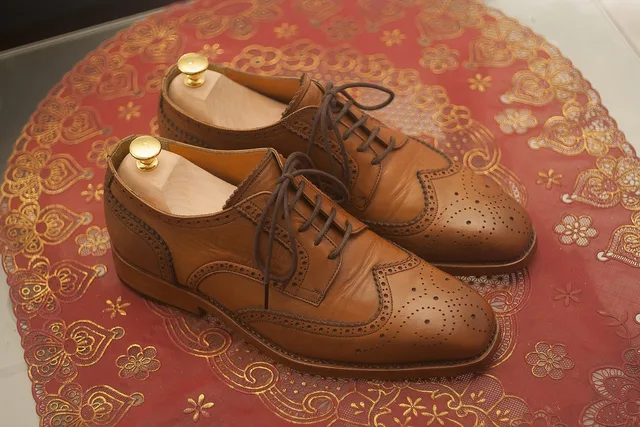
Put a shaped tree in, or failing that, stuff the toe with paper. A shoe holds the shape it dries in, and it dries overnight.
Wipe the upper with a dry cloth. This takes ten seconds and removes the grit that would otherwise be ground into the surface by the next polish.
Then rest the pair for a day. That single habit does more than every product, for the reasons set out in the guide to work shoes.
Weekly
| Task | Why | How long |
|---|---|---|
| Brush the uppers | Removes dust from the seams and the welt, where it holds moisture | One minute |
| Check the heel tips from behind | A worn tip is minutes; a worn heel block is a real repair | Ten seconds |
| Look at the sole edge for a stitch line lifting | Early separation can be restitched; late separation cannot | Ten seconds |
| Check the laces at the eyelets | A lace fails at the point of most friction, always at the wrong moment | Ten seconds |
| Rotate which pair is in use | Nothing else extends the life of a shoe as much | Free |
Monthly
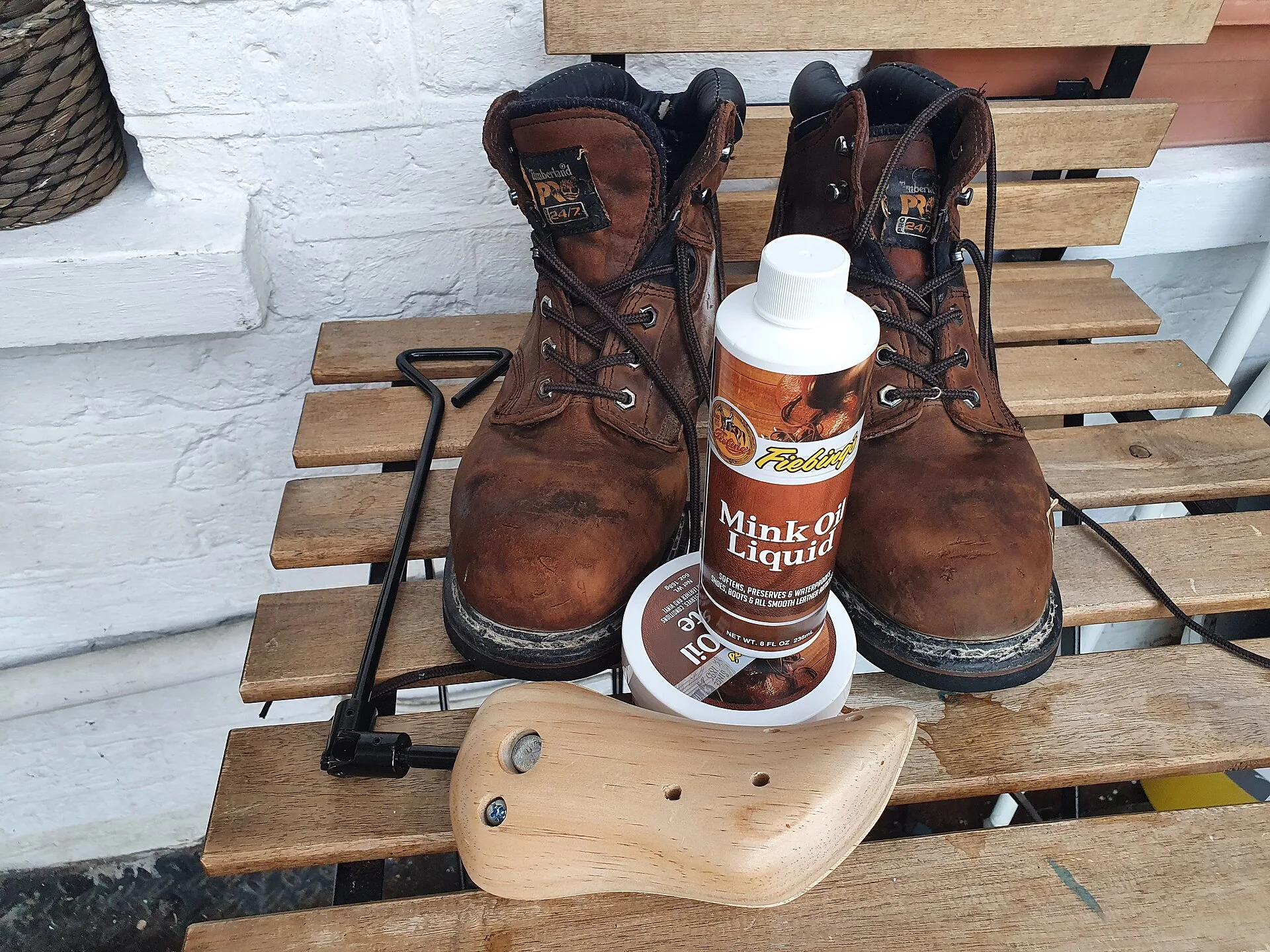
Clean and condition. Clean first, with a damp cloth and a mild cleaner, and let the shoe dry before anything else goes on it. Then condition, which feeds the leather and prevents the crack at the flex point across the toe. Then polish, if you polish, and only then worry about shine.
Monthly clean and condition order
- Clean with damp cloth and mild cleaner
- Let the shoe dry completely
- Condition the leather
- Polish only after conditioning
- Check the insole for compression
Doing this in the wrong order is the most common mistake in shoe care. Polishing over dirt grinds grit into the surface and produces a duller result than doing nothing.
Check the insole at the same time. A compressed insole changes how the whole shoe fits, and on many shoes it can simply be replaced. A compressed insole is one of the wear points a men's professional wear checklist covers at the twice-yearly audit.
Twice a year
Deep condition everything, including the pairs that have been resting. Leather dries out in storage as well as in use.
Twice-yearly shoe audit
- Deep condition every pair, including resting ones
- Assess all pairs for repair at once
- Store out-of-season pairs clean, dry, with trees
- Keep away from direct heat and sealed plastic
Assess every pair for repair. Heel tips, a resole where the construction allows one, and restitching where a seam has opened. Take the whole set at once rather than one pair at a time, because a repairer will price a batch better and because you will otherwise never take the second pair.
Then store the out-of-season pairs properly: clean, dry, with trees in, away from direct heat and out of sealed plastic. The same storage logic that governs the rest of the wardrobe applies here and is set out in the guide to men's professional wear.
The soaked shoe
This is the procedure that saves a pair, and it has to start immediately.
Drying a soaked shoe
- Wipe off water and remove laces
- Stuff firmly with plain paper, toe first
- Change paper after one hour
- Air-dry at room temperature, never heat
- After two days, condition the leather
- Wipe off surface water and remove the laces.
- Stuff the shoe firmly with plain paper, filling the toe first, and change the paper after an hour.
- Put the shoe somewhere with moving air at room temperature. Not a radiator, not a heater, not direct sun, and not a heated drying cabinet.
- Leave it a full day or two, changing paper once more.
- When it is completely dry, condition it. Water pulls oils out of leather as it leaves, and a soaked shoe that is not fed afterward will crack.
Fast heat is the failure. It shrinks and stiffens the leather, and no amount of conditioning brings it back.
The salt problem
Salt from a treated sidewalk leaves a white tide line and continues to draw moisture out of the leather while it sits. It is not a cosmetic issue and it does not wait.
Remove it the same evening with a cloth dampened with water and a small amount of vinegar, wipe with plain water, dry slowly as above, then condition. Left for a week, the mark becomes permanent and the leather beneath it becomes brittle.
What is not on this list
Nothing here addresses fit, because care cannot fix a shoe that does not fit. Nothing here addresses construction: whether a shoe can be resoled was decided when it was made.
What care does buy is condition. Condition is part of the specification, not a nicety at the formal end of the range, as the guide to business formal sets out.
Where footwear is worn as protection rather than as clothing, its inspection and maintenance are governed by the employer's program rather than by preference. The general obligation to keep such equipment in a sanitary and reliable condition sits in the OSHA general requirements for personal protective equipment. Which roles that covers is described in the guide to industry dress codes.
The relationship between sole surface and floor surface is what makes a well-kept shoe a safety matter as well as an appearance one. It is set out in the OSHA guidance on slips, trips and falls.
Common questions
Are shoe trees worth buying?
Yes, and they are the highest-value item in shoe care. They hold the shape while the shoe dries and they flatten the creases that would otherwise set into folds.
How often should a shoe be polished?
Less often than most people think. Conditioning is what the leather needs; polish is a surface finish. Monthly conditioning and occasional polishing beats weekly polishing over a shoe's life.
Can a collapsed heel counter be repaired?
Sometimes, by a repairer, on a well-made shoe. It is rarely economical on anything else, which is why not levering shoes off is worth the two seconds.
Does any of this apply to synthetic uppers?
The cleaning and the drying do. The conditioning does not, because there is nothing to feed, and that is exactly why coated uppers crack instead of creasing.